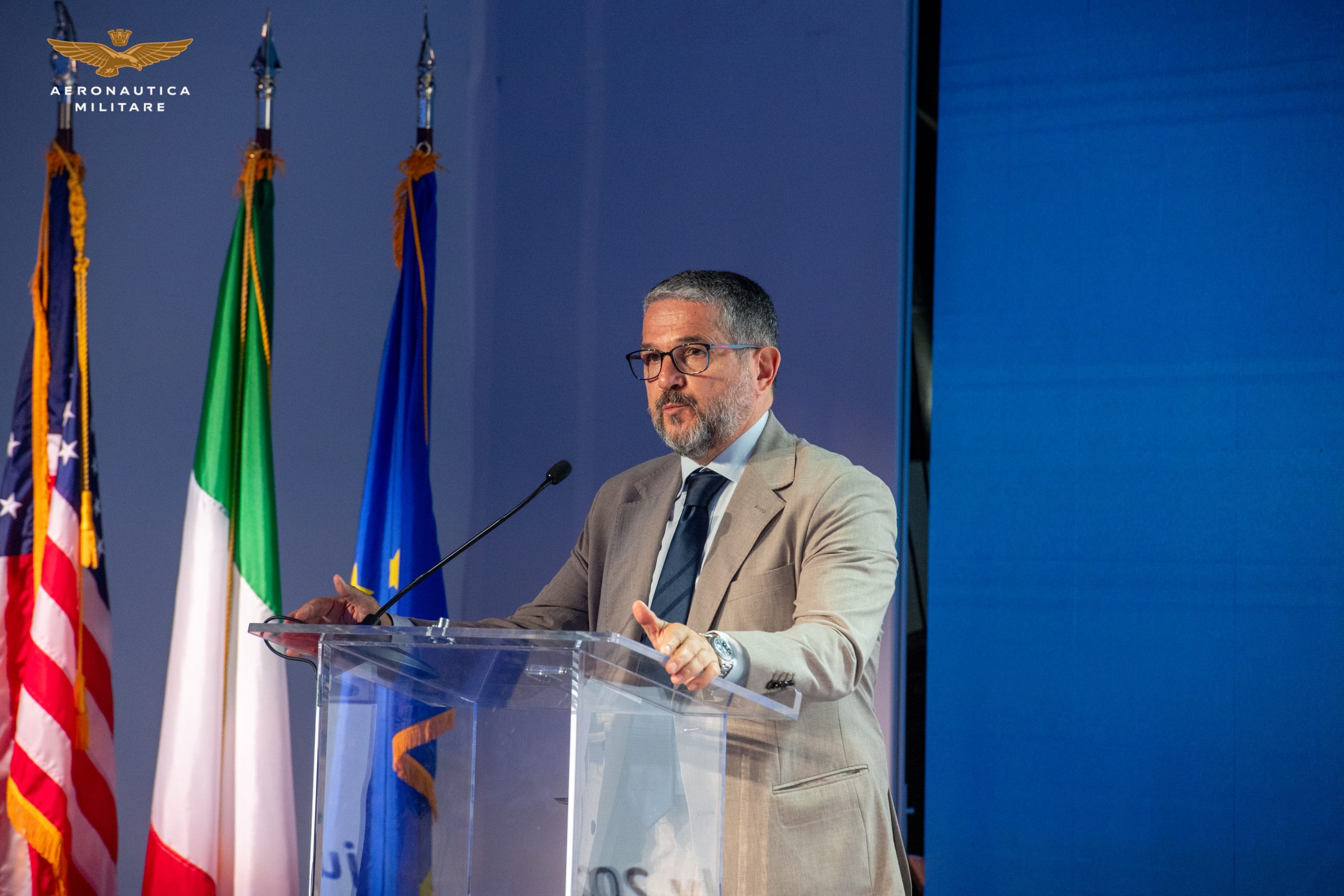
A meeting between leading aerospace companies, institutions and astronauts from Italy and the USA to discuss opportunities and prospects in low Earth orbit and future lunar missions
Last July 7th in Los Angeles, as part of the program of events promoted within Villaggio Italia, an international conference was held, curated and organized by the Italian Air Force entitled “Space economy exploration: opportunities and prospects for Italy”.
The event, opened by the speeches of Deputy Minister of Enterprises and Made in Italy, Valentino Valentini, and Deputy Minister of Defense, Matteo Perego of Cremnago, He brought together representatives of leading aerospace companies, institutions and Italian astronauts for a discussion on the issues concerning opportunities and prospects in low Earth orbit and future lunar missions.
In particular, during the conference, the opportunities offered to the Sistema Italia by the space economy and the potential prospects for collaboration between the public and private sectors were explored, along with the partnership with the United States and future space missions.
The role of Italy is important through the’Air Force – as he recalled Air Force General Francesco Vestito, on behalf of Chief of Staff of the Air Force, Air Team General Luca Goretti – as a “facilitator” of future activities thanks to his expertise in the aerospace domain.“Space belongs to everyone and is an area of fundamental importance in today’s scenario. Our main objective, thanks to initiatives like this, is to build a shared vision of cooperation in the field of the space economy. As aviators, we consider space as a continuation of aerospace, an area that must be safe, secure and prosperous, managed with total safety thanks to consolidated and standardized skills and expertise at an international level. As the complex international scenarios also confirm, a lot, also in terms of communication capabilities and therefore security, passes through space.”
The space economy Opportunities for collaboration and diversification were the topics discussed in the first panel, in which the astronaut took part along with the other participants. of the Air Force Colonel Walter Villadei, The Chief Astronaut of Axiom Space, Michael Lopez Alegria, Sirisha Bandla, Vice President of Government Affairs and Research Operations at Virgin Galactic, Francesco Curia, Head of the Artificial Intelligence Area of Defense and Systems Analysis (DEAS) and the Head of the Department for Business Policies of the Ministry of Business and Made in Italy, Amedeo Teti.
“The Axiom-3 mission – Colonel Villadei stated – It approved a new model, a mission led by the Ministry of Defense, with the Air Force joining together with the Italian Space Agency to bring together various entities from the scientific community, but also the world of industry, including those that do not belong to the traditional defense and aerospace sector and that represent a huge opportunity for the space economy. Italy has known excellence worldwide. In the mission I flew in January, we brought together companies from the automotive, fashion and food sectors: these entities, brought together and made to speak with the aerospace sector within the space economy, will create extraordinary growth opportunities in terms of innovation, research and market opportunities for Italy as well.”.
The second panel, on the other hand, addressed topics related to international relations, security, and innovation in the aerospace sector, and saw the participation of Brigadier General of the Air Force e European Space Agency astronaut Roberto Vittori, del Director of International Affairs of the Air Force Space System Command Deanna Ryals, of’Chief Executive Officer of Vast Space Max Haot, and Frank Webb, Program Manager of the NASA Jet Propulsion Laboratory.
“Space is growing exponentially”, General Vittori declared. “Space is security and defense, it is scientific and technological research and, above all, a driving force for the global economy. There are many aspects why space has become of strategic importance. In this historical moment, the three operational domains are the aerospace one, which represents the economic and efficient access to space, and the field in which aeronautics worldwide have a leading role and responsibility; then we have the Earth orbits, with the satellite platforms and services, which today characterize the space economy more than ever; and finally the lunar and planetary orbits, which represent the real challenge through access to extra-atmospheric resources and that will significantly change the opportunities of the space sector as a whole.”.