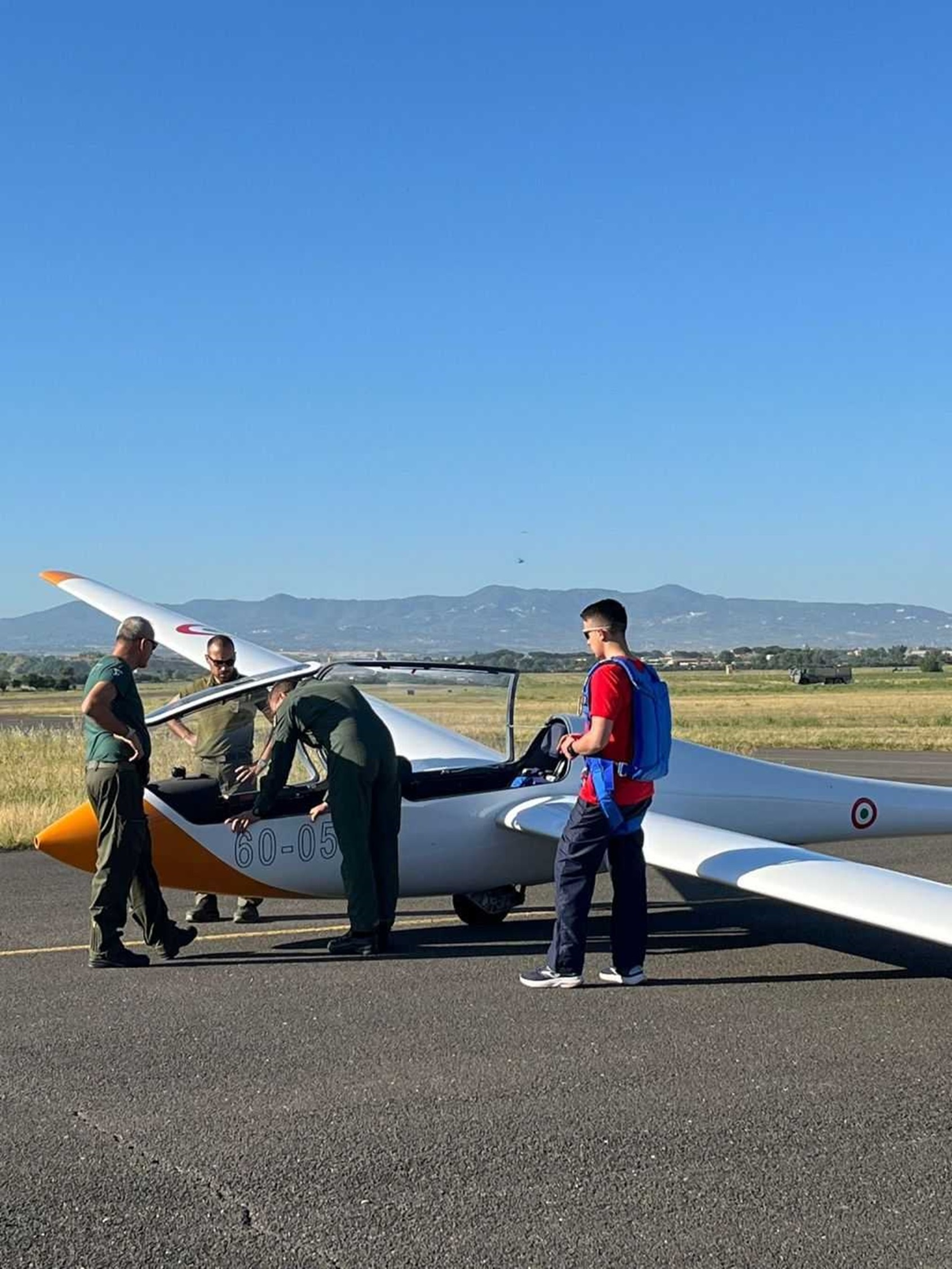
The “Giulio Douhet” Military Aviation School, located in the historic complex of the Institute of Military Aviation Sciences, was inaugurated in Florence in 2006. The School is a secondary education institution that offers courses for the final three years of secondary education, in classical and scientific streams, admission to which is by competitive examination.
The humanities and scientific education, as set out in the Educational Offer Plan in accordance with the ministerial programmes for the final three years of the Classical and Scientific Lyceum, is supported by multiple cultural, sports and educational activities.
The educational programming is developed on a full-time basis with collegial organisational methods. It also involves strong interaction between the school environment and the social community, with particular reference to the artistic and cultural context of the city of Florence.
The Institute's aim is to foster balanced growth in its pupils in terms of their humanity, culture, morals, physical well-being, and character, so that they possess the necessary skills to face the challenges of tomorrow.
Boys and girls who gain access to Douhet School have the opportunity to experience new things with their peers from all over Italy, immersed in a formative environment that aims to promote an educational action aimed at moral elevation and personality development, with particular emphasis on the sense of duty, loyalty, discipline and respect.
Clear and unambiguous rules and the valuing of merit: each boy and girl builds their own life starting from here, cultivating their passions, discovering their talents and preparing for a brilliant future, both in the eventual continuation of military life and in the civilian sphere.
For any information regarding the educational offering, extracurricular activities, and admission selection procedures for the Douhet School, please download the brochure by clicking on the link below.
School Guidance Desk
The school guidance services are available to you, by appointment, on Tuesdays and Thursdays, from 2:30 PM to 4:00 PM, at our premises.
For bookings, interested families or educational institutions can contact the following details from Monday to Thursday between 09:30 and 11:30 and between 14:00 and 16:00:
Telephone 055 2704806/5/4
Email: aeroscuoladouhet.con@aeronautica.difesa.it
For the 2026 competition announcements, consult the Defence Competitions Website.
The study programmes followed are those established by the current regulations for upper secondary education institutions, supplemented with military-style instruction, sports activities, and aeronautical education.
For curriculum and extracurricular educational aspects, please refer to the Three-Year Plan for the Educational Offer (P.T.O.F.).
For further information, please refer to the Competition Notice.
The public notices for admission to the Academies of the Armed Forces and the State Armed Corps provide for a quota of places reserved for Cadets from Military Schools.
Italian Air Force Headquarters – UCOM
2nd Public Relations Office
Viale dell’Università n.4
00185 ROME
06.4986.6626
Opening hours: Monday – Thursday 08:30-15:00 Friday 08:30-11:30
Ministry of Defence - Directorate General of Military Personnel (Persomil)
Palazzo Muscoloni
Viale dell’Esercito 186
00144 ROME
06.5170.51012
Military Aviation School Giulio DOUHET – Competitions Office
Viale dell'Aeronautica 14
50144 Florence
055.2704806
Dear applicant,
The purpose of this section is to answer questions (FAQ – Frequently Asked Questions) on the main aspects relating to the School, in order to provide a general overview of both the selection procedures and life at the School. In particular, for the selection phase, the Notice of Competition will be the reference document for all detailed aspects. Therefore, the questions below are not to be considered exhaustive, and for any further information, please refer to the availability of the Competition Office staff (contacts:
aeroscuoladouhet.con@am.difesa.it
or 0552704804-5-6) and/or to the scheduled in-person/virtual Open Days. For curricular/extracurricular educational aspects, please refer to the Three-Year Education Offer Plan (P.T.O.F.).
Can I keep and use my mobile phone?
Mobile phones are permitted, but their use will be regulated. As a general rule, their use is not allowed during school hours, compulsory study, or during sports and extracurricular activities.
2) Can I access social networks (Facebook, Instagram, TikTok, etc..)?
Students may have social media profiles, but it is strictly forbidden to disseminate any news, information, or audiovisual material relating to the service, personnel, locations, or military equipment, in absolute compliance with current laws and regulations. As military personnel, students are bound to respect precise directives regarding the responsible use of social networks, which require abstaining from any behaviour that could damage the prestige of the institutions.
3) What is the legal status of the Apprentice?
Cadets are enlisted “on application” and with the consent of the person exercising parental authority. They undertake a “special” commitment of 3 years, aimed at completing the course of study, which may be extended by a further year in the event of a failed promotion during the entire three-year period.
4) If I realise that military life isn't for me, am I forced to stay at the school?
It is always permissible to resign through “voluntary withdrawal”. The parent or guardian, or the adult student, can obtain withdrawal from the school at any time during the academic year, with the consequent release from any commitment.
5) Who is the point of contact for families?
The main points of contact for each student are the Course Commander and the Commanders of the Courses. Furthermore, school-family communication regarding academic matters will take place via the “Argo” platform, telephone consultations with teaching staff, and two additional in-person meetings during the general parent-teacher evenings.
6) When can I go out/see my family?
Outside leave is granted on public holidays and the day before public holidays, and on Wednesday afternoons. The granting of outside leave will be regulated and managed throughout the course of studies. At the beginning of the first year, only Sunday will be granted (initially from early afternoon) and this will subsequently be extended to other days of the week, depending on the student's academic progress.
7) Can I go home or stay with relatives now and then?
Yes, a student deemed worthy, in the absence of school shortcomings, may request a weekend leave permit. Even in this case, the granting of weekend leave will be regulated and authorised in a gradual manner. It is still understood that Christmas, Easter leave and a further 35/40 days during the summer period will be guaranteed.
Can I keep up the habit of studying late in the evening and/or at night?
No, the sound of silence in the evening marks the end of all daily activities. Exceptionally, if authorised by the Course Commander, study may be permitted until 11:25 PM.
9) Can I continue to participate in competitive sport with my club/team?
Generally, it is not possible. The pupil's daily activities take priority and do not allow for constant and frequent competitive commitments.
10) What types of sports are practised?
In addition to the curricular educational activities included in the Physical Education lessons, the following sports disciplines can be practiced: Athletics, swimming, volleyball, basketball, pistol shooting. The educational offer plan is in continuous and constant evolution, and the School is ready to seize any opportunity present in the local area. Of the aforementioned activities, swimming and athletics constitute the fundamental sports disciplines.
11) How are optional sports allocated?
A training project is planned to enhance the Cadet's abilities both physically and athletically, as well as in character. Specifically, during the academic year, “differentiated sport” teams will be established which will undertake supplementary training sessions. These teams will represent the School in competitions against equivalent Army and Navy institutions during the Inter-School Military Tournament. In the third year, sporting activities will also be focused on preparing for the physical tests required for access to the Academies.
12) Can I continue attending the music/dance/computer/driving licence/etc. course whilst being a student?
It is possible, for limited-time activities and only if the course is held outside of working hours (free leave), provided that the commitment is compatible with all activities planned in the weekly operational schedule. Among the extracurricular activities, the Music Course, Choir (subject to academic progress), and the acquisition of the ICDL IT certification are, however, foreseen.
13) What are the typical military activities that are carried out daily?
The flag-raising ceremony marks the beginning of daily operations. Formal instruction and theoretical-practical basic military training lessons are also carried out daily. The Three-Year Training Offer Plan (P.T.O.F.) also includes Familiarisation Courses for Mountain and Sea Survival and an introduction to flying through the “Young Eagles” course (Glider and powered aircraft flights from the 60th Wing of Guidonia, opportunity to obtain a Recreational Pilot's Licence from Italian Aeroclub locations, motivational flights at Air Force bodies and departments).
14) Are all the activities planned in the P.T.O.F. mandatory?
YES, meaning that they are subordinate to the educational and disciplinary performance of the Pupil. Specifically for the Young Eagles-VDS Certificate activity, participation is granted at the discretion of the family.
15) Is it possible to have some more information about school trips in Italy and abroad?
During the school year, the students undertake cultural visits to historical and artistic locations - in the first year to nearby places and subsequently to locations throughout the country. In the second and third years of the course, the possibility/opportunity of organising educational trips to European countries (generally France) is evaluated, also through exchange activities with equivalent European schools.
16) What study addresses are provided at Douhet?
It is possible to attend the three-year course of the Classical and Scientific Lyceum with a traditional curriculum.
17) My son has a “specific learning difficulty” / has been recognised as having “special educational needs”. Can he still apply?
To be deemed eligible, candidates must be free from imperfections and/or infirmities provided for by current legislation on unfitness for military service pursuant to Articles 580, 581 and 582 of Presidential Decree of 15 March 2010 number 90 (T.U.O.M.). With regard to this, please refer to the analysis of the requirements specified in the individual competition announcements for the year in question.
What is studied besides the subjects required by the secondary school curriculum?
Over the three-year period, students are offered educational projects aimed at consolidating their academic skills, as well as a range of extracurricular activities on both academic and transversal topics. These are designed to stimulate curiosity, explore new themes, including from a university perspective, and discover any hidden talents or abilities. The aim of all this is to enable students to acquire the knowledge and skills necessary to fulfil the School's purpose, which is to integrate excellent citizens into society, regardless of their future life plans.
19) Which foreign languages are studied at Douhet?
English is studied at the school, and French as a second language. The latter is not assessed during competitive examinations, considering that no prior knowledge is required; the teaching programme starts from basic communicative/grammatical skills and develops over the three years in order to prepare students to tackle the tests for DELF (diplôme d’études en langue française) certification.
20) I live and work far from Florence. How can I keep in touch with my child's teachers?
It is possible to arrange telephone and/or ARGO video calls, according to the teachers’ office hours. Furthermore, a general in-person meeting with teachers is guaranteed – generally twice per academic year.
21) Can a non-Catholic attendee request not to attend Catholic religious instruction?
Yes. However, it should be noted that religious education is not merely the teaching of Catholicism, but an opportunity for reflection, open discussion, and the exchange of opinions and experiences. In fact, it covers the historical and cultural aspects of all major faiths and is a moment to explore social, current, or youth-related topics. Therefore, it is a complementary educational and formative path, aimed at stimulating students' critical and personal development.
22) Are there any internship or work-related learning activities planned?
The specific nature of the Military School exempts cadets from the requirement to obtain educational credits through work-related learning activities. However, in partnership with local institutions, universities, organisations, and businesses, the Douhet School can also offer high-level internships and professional experiences to the most deserving and interested students.
23) If I am not admitted to the next academic year, will I be dismissed from the School?
No, but it is not permitted to repeat more than one year within the three-year period.
24) Where can I find all the instructions for entering the competition?
The call for applications is published on the institutional websites www.concorsi.difesa.it, on the portal www.inPA.gov and relaunched on the Armed Forces' website www.aeronautica.difesa.it.
When is the competition published?
Generally by March, meaning that it is suggested to follow the Air Force website as early as January to stay updated on the School's initiatives, including Open Day sessions.
26) How are summons or communications made after the application has been submitted?
Through their personal profile on the portal www.concorsi.difesa.it (which the interested party creates upon first access using their CIE – Electronic Identity Card or SPID), the applicant will receive strictly personal communications in the private area and collective communications in the public area. All communications have legal notification value. Solely for collaborative purposes, further alert or supplementary messages may be sent by the Competitions Office to the email address provided during the application submission phase.
27) Is it possible to apply for both Army and Navy Schools at the same time?
Yes, the call for applications is a single one for all Military Schools and it is possible to submit an application for more than one institute at the same time.
What are the minimum requirements to participate in the competition?
29) What proof is there of the competition's progress?
The competitive examination generally provides for:
The Call for Applications details each individual test specifically (type, timings, scores, etc.).
I'm already in my 3rd year. Can I enter the competition?
NO. Only students in their second year of senior secondary school are permitted to enter the competition, and they must gain admission to their third year upon its conclusion.
31) I attend the first two years of a Senior High School different from a *Liceo*. Can I apply?
Yes. If you are a winner of a competition, before enlistment, it is necessary to document that you have passed the supplementary examinations in the subjects of your chosen course at a state or recognised private educational institution. Furthermore, the Competition Announcement details the timing and methods for producing the required documentation.
I am attending the equivalent of the 2nd year of high school abroad / I will be admitted (in the current school year) to the equivalent of the 3rd year abroad. Can I apply?
If admission to the 3rd year is obtained abroad, a declaration of equipollence or equivalence of any foreign qualifications acquired is required (procedure provided for by art. 38 of Legislative Decree of 30/03/2001, n. 165).
Are there any reserved places? For which categories?
Yes, for war orphans and for children of civil and military state employees who have died from wounds, injuries, or infirmities sustained in service and/or due to service (subject to suitability upon completion of the competitive examination).
34) How do I enter the competition?
The application for participation in the competition must be submitted solely through the Defence portal (after registering on the website). www.concorsi.difesa.itAccess to the system is guaranteed through the CIE – Electronic Identity Card or SPID. Given the time required to produce the aforementioned type of digital documentation, it is suggested that you act promptly if you do not already possess it.
35) If I have a confirmed and documented allergy and/or intolerance (food-medical), can I submit an application?
The submission of the application is always permitted. It will be the medical commission during the selection process, pursuant to articles 580, 581 and 582 of the Presidential Decree of 15 March 2010 n. 90 (T.U.O.M.), that will decree whether the allergy/intolerance is a factor for exclusion or is compatible with military status.
36) I was born in a foreign country. Can I enter the competition?
Yes, if you possess Italian citizenship (and the other requirements stipulated in the announcement).
37) At the end of the three-year period, do I automatically have the right to access military academies?
NO. It is necessary to pass all competitive examinations and to be in a useful position in the rankings at the end of them.
38) Is there a reserved quota of places for Cadets from Military Schools?
There is a reserved quota of places for entry into the Air Force Academy in 20%. There is also a 10% reserved quota of places for the remaining Defence Academies (Army and Navy)%.
39) What kind of advantage does the School therefore offer for access to military academies?
The regulatory advantage offered is inherent in the reserved places granted to competitors who attended Military Schools. The practical advantage consists of the opportunity, as a student of the Military School, to test one's own ability to adapt to military discipline and life, and to gain real awareness of the essential value system for serving one's country. Not least, the flying activity carried out during the three years will contribute to the acquisition of basic skills, which are a prerequisite for the subsequent flight examination should one apply for flight roles.
40) Can I receive information directly from the School regarding the competition, calls for applications, dates and results of tests, and rankings?
Yes. The staff of the Douhet School Competitions Office are available for any clarifications and/or explanations. The contact numbers are 0552704804-5-6 from Monday to Thursday (07.45-15.30) or on Friday (07.45-11.00).
Can I reclaim expenses incurred to take the competition tests?
No. The midday meal is generally provided only for medical examinations and aptitude tests. In the first case, the cost is borne by the candidate, while for aptitude tests, the School will provide mid-morning/afternoon snacks and the midday meal free of charge.
42) What is the annual fee for attendance?
It is the responsibility of families:
The Notice of Competition details the above-mentioned quotas, the ISEE limits, and the methods/timings for payment and reporting.
43) Are attending pupils insured?
YES. The School will activate a specific policy with the above-mentioned funds for young people in their capacity as pupils of the Military School. In the event of withdrawal at the pupil's request, the policy coverage will automatically lapse regardless of the temporal criterion in force.
44) How much is paid for board and lodging?
Nothing. The costs for uniforms, educational activities (including extracurricular ones), school trips, and general training activities (various courses, sports activities, theoretical-practical course for obtaining a licence) are also borne by the Administration.
45) Do the pupils receive a wage?
Yes, the monthly salary is around €130.
46) Where do the pupils sleep?
The accommodation, segregated by sex, offers rooms for 4 to 8 people, depending on the size of the premises. Common areas are under video surveillance and are attended daily by the Officer of the Guard for Trainees (a military member of the school on dedicated duty).
47) Should I choose a doctor from the ASL of Florence?
The school already has an agreement in place with an ASL doctor in Florence for all students. Choosing to use a general practitioner in the city of Florence is strongly recommended.
48) Who visits me in the morning if I don't feel well?
The School has an infirmary with the possibility of admission and guarantees continuous care for the Cadets, availing itself, in case of emergency/urgency and/or for specialist services, of the SSN (National Health Service) hospital facilities (Careggi Hospital. This means that the Cadet will be accompanied and assisted by dedicated military personnel).
49) Can I use my own doctor of choice or have a specialist examination privately?
YES, always. The obligation to inform school healthcare staff remains to coordinate any necessary leave/permits, etc.
What happens if, for a period, a Pupil is sent home due to an injury?
In the event of illnesses and/or injuries that prevent the Student from remaining at the School, they will be granted leave for convalescence at their home for the necessary duration established by the Head of the Health Service. In cases of prolonged hospitalisation, even if absent, the opportunity to follow lessons online may be granted.

 State Exam 2026 – Classical High School