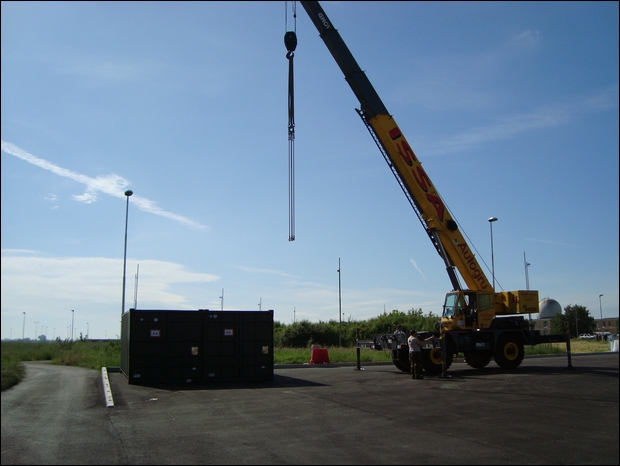
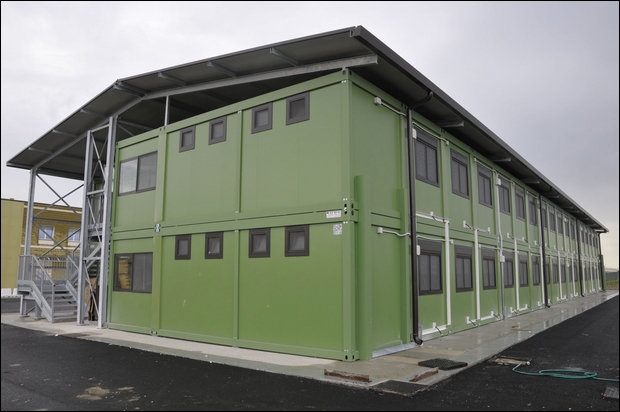
First mobile structures arrive at the newly established Deployable Air Command and Control Centre. The implementation phase of the DACCC received further impetus on 14 May with the arrival in Poggio Renatico of the first mobile deployable radar structures (DARS – Deployable Air Control Centre – Recognised Air Pictures Production Centre – Sensor Fusion Post) from their location in Nieuw Milligen (Netherlands). This movement will be completed by the end of June in order to begin, on 1 July, the training phase for personnel assigned to the new NATO entity. The entire operation is managed by the DACCC Service Support Division in coordination with the local General Services Support Department (RSSG) of the COA and the 27th Field Engineering Regiment from Villafranca (VR). The creation of the DACCC has marked a new beginning for the NATO presence in Poggio Renatico. The DACCC is the first unit of its kind and has been conceived to provide flexibility to NATO's air Command and Control structure. The need for this new Command arose from the consideration of evolving international scenarios, with an increased emphasis on the requirement to be able to control air operations well beyond the territory of the Alliance's nations. Hence, NATO felt the need to acquire the Command and Control capabilities typical of a CAOC (Combined Air Operations Centre), but based on mobile and deployable structures, just as operational forces have long been mobile and deployable.
This website uses technical and analytical cookies, including third-party cookies, to improve its services. By continuing to browse, you will automatically accept the use of cookies.
This website uses cookies to improve your experience as you navigate the website. Of these, cookies categorised as necessary are stored on your browser as they are essential for the working of basic functionalities of the website. We also use third-party cookies that help us analyse and understand how you use this website. These cookies will be stored in your browser only with your consent. You also have the option to opt-out of these cookies. However, opting out of some of these cookies may affect your browsing experience.
Necessary cookies are absolutely essential for the website to function properly. These cookies ensure basic functionalities and security features of the website, anonymously.
Functional cookies help to perform certain functionalities like sharing the content of the website on social media platforms, collecting feedback, and other third-party features.
Performance cookies are used to understand and analyse the website's key performance indicators, which helps in delivering a better user experience for visitors.
Analytical cookies are used to understand how visitors interact with the website. These cookies help provide information on metrics such as the number of visitors, bounce rate, and traffic source.
Advertising cookies are used to provide visitors with relevant advertisements and marketing campaigns. These cookies track visitors across websites and collect information to provide personalised ads.