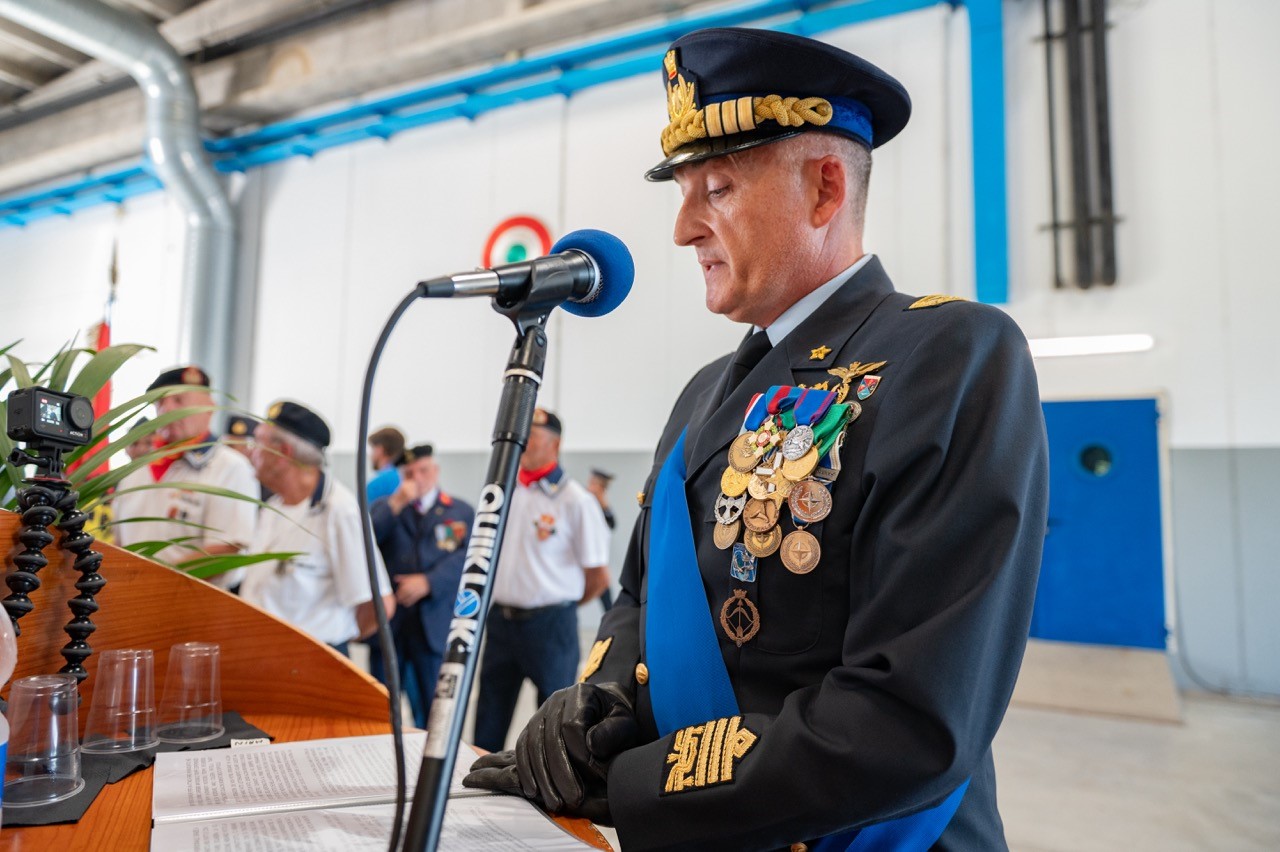
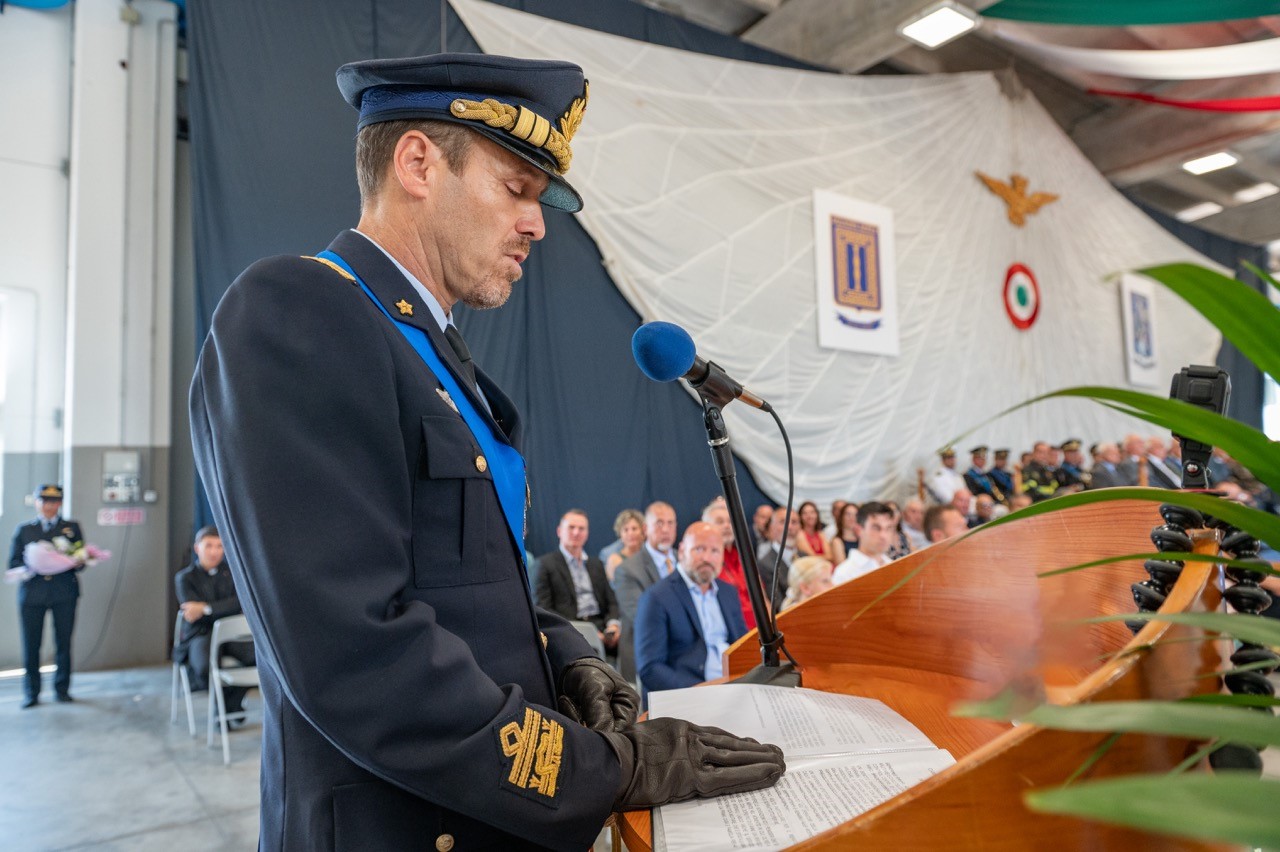
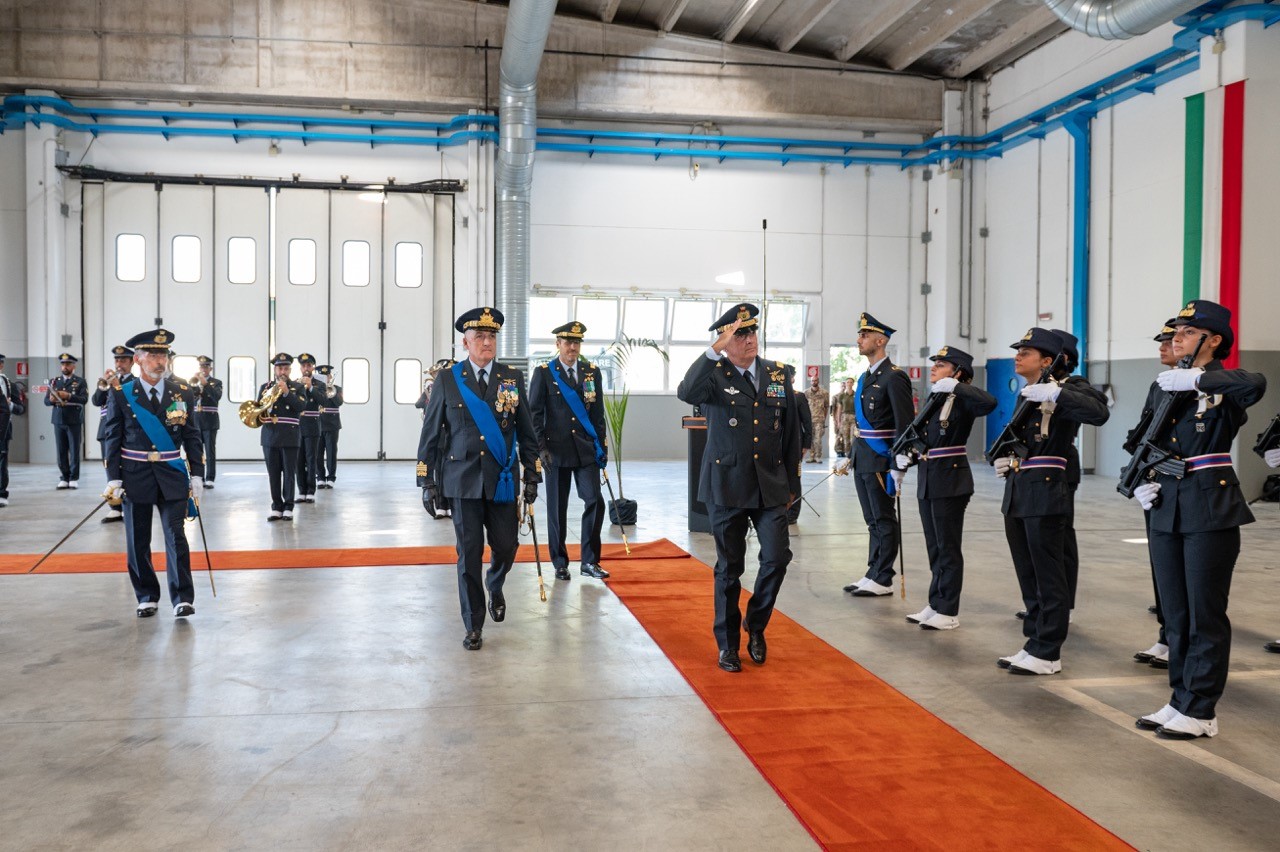
Ceremony of succession at the base of the Aeronautica Militare of Poggio Renatico in the presence of the Commander of the Air Force, the personnel and the local authorities
The Air Force’s Air Operations Command (COA) has officially appointed a new Commander. The ceremony of succession between Air Squadron General Claudio Gabellini and Air Division General Luca Maineri took place at the Poggio Renatico (FE) base today, Friday 30 August.
The event was attended by the Commander of the Air Force Command, Air Force General Alberto Biavati, the Mayor of Poggio Renatico Daniele Garuti, the Prefect of Ferrara Massimo Marchesiello and many local military and civil authorities.
The change of command is always a very significant ceremony, not only by the protagonists but also by all the staff members. However, the handover between General Gabellini and General Maineri was unique for at least two reasons: the long period during which the outgoing Commander was in charge of the COA (since March 2019) and the fact that the one who succeeded him was the one who held the role of “Deputy” For over two years, that is, precisely General Maineri, who until August 29 was also the Commander of the Operations Department, the component that represents the “operational staff” of the COA.
The farewell speech took on a special meaning for General Gabellini, who leaves the COA command as well as active duty after 44 years, many of which were spent in Poggio Renatico. A command that, as General S.A. Gabellini recalled in his speech, “It has been redesigned and transformed, in all respects, into the true catalyst of the transformation process of an Air Force that has gone from simply flying to being able to carry out complex aerospace operations. A command capable not only of ensuring, without interruption, those operational functions essential for safety and the collective well-being, but also of carrying out truly unprecedented operations, such as the planning and execution of the Aquila Omnia operation, during which, with a unique air bridge from its home base, due to the number of assets deployed and above all the highly risky context, the Air Force saved the lives of approximately 3300 Afghan citizens, transporting them safely from Kabul to Italy, all during Ferragosto and in the midst of the Covid 19 pandemic.”
General D.A. Luca Maineri, in his first intervention as Commander, wanted to emphasize how “The spirit that will animate and guide the actions of each woman and man of the COA will be to fulfill their mission with excellence, aware that only by working together towards a common goal can we meet the challenges that the future holds for us. The reform process affecting the Command and Control sector in the Armed Forces and in NATO, to which the evolution of the international scenario resulting from the ongoing conflicts characterized by complexity, unpredictability and volatility will be added, will require new knowledge and skills; a challenge of great magnitude that will require the commitment of everyone to be overcome.
As the superior commander of the COA, General Biavati, Commander of the Air Force, emphasized that “The COA, which effectively represents the driving force behind the entire Armed Forces, has been the protagonist of the numerous operations successfully carried out by the Air Force. We are facing an international crisis in which the Air Force is directly involved to ensure the safety of NATO’s skies, and this is only possible thanks to the tireless commitment of highly specialized military personnel. The challenges we are facing are pushing us beyond the concept of national security, and the recent campaign in the Indo-Pacific has demonstrated the expeditionary capability that is part of the strategy the Armed Forces have been developing for some years now.”
During the period of General Gabellini’s command, the COA underwent several evolutions, both in terms of organizational structure and operational aspects, expanding its competencies (firstly the capabilities in the domain of space) and adapting its structure in accordance with the paradigms of a modern Armed Force characterized by well-defined functions and equally well-integrated ones.
There are many notable events that have taken place over the years. Just to mention a few: from the Covid “challenge” (2020-’21) to the management of Operation “Aquila Omnia” (2021), in which an air bridge was established to evacuate Afghan civilians from Kabul; the celebrations of the Centenary in 2023, which culminated in the conferment of honorary citizenship of Ferrara; and also the major events involving the COA, such as the G20 in Rome (2021) and the recent G7 in Puglia.
The Air Operations Command, it is worth remembering, is one of the most significant employment entities in the province of Ferrara, boasting approximately 1000 employees (military and civilian) in its national facilities, in addition to over 200 units employed by NATO entities (DACCC – Deployable Air Command and Control Centre, and NCIA – NATO Communications and Information Agency) and international (EPRC – European Personnel Recovery Centre) located in the Poggese base. Conscious of this role, the COA has always pursued greater social responsibility, in order to contribute to a social fabric that has always been linked by esteem and affection towards the military community.
It Aerospace Operations Command Based in Poggio Renatico (FE), it plans and conducts complex aerial operations in any theatre. The COA exercises Command and Control over permanent operational activities from peacetime onwards, both domestically and in theatres outside national borders. It is also the doctrinal reference point for the use and development of Air Power. These functions are carried out 24 hours a day, 7 days a week, without interruption, through the national Operations Rooms located within the base.