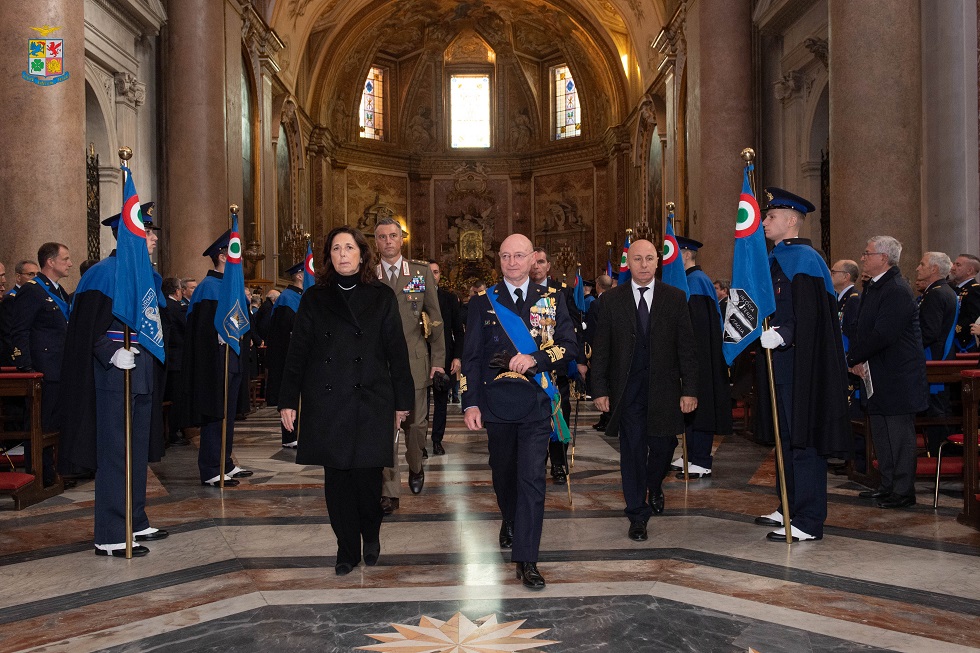
Madonna di Loreto: The Italian Air Force celebrates the Virgin of Loreto, patron saint of all aviators
The solemn celebration was held this morning in Rome at the Basilica of Saint Mary of the Angels and the Martyrs.
The solemn celebration in honour of the Blessed Virgin of Loreto, Patron Saint of Aviators, was held on the morning of Monday, 12th December, at the Basilica of St. Mary of the Angels and the Martyrs in Rome.
The religious service was officiated by Monsignor Antonio Coppola, Episcopal Vicar for the Air Force, and saw the participation of the Undersecretary of State for Defence, Senator Isabella Rauti, the Chief of Staff of the Air Force, Air Force General Luca Goretti, numerous authorities, and a contingent of military and civilian personnel from the Armed Force's bodies.
The Episcopal Vicar in his homily stressed “Just as in the Angel's annunciation to Mary, God did not impose himself but rather offered himself, respecting the invaluable gift of freedom. Precisely through being free, the Holy Virgin trusted and entrusted herself. In flight, referring to the Old Testament which poetically speaks of eagles, we find a great expression of freedom, but without ever losing sight of every rule that safeguards everyone's freedom.”. In conclusion, he also stressed that “The Holy House recalls the value of the family as a sign of unity and salvation.”.
The Chief of Staff of the Air Force, at the end of the ceremony, wished to thank Don Antonio Coppola for the precious moment of reflection that he intended to share with his words during the homily, emphasising how all the personnel of the Air Force are driven “through passion and faith in the Armed Forces' War Flag, to which we have sworn loyalty unto the last sacrifice, and in relation to Our Lady of Loreto, to whom we entrust ourselves whenever there is a moment of difficulty, a dark moment not only in our professional lives but also in our daily lives.The General Goretti finally stressed that he felt ”proud to be here today with all of you to thank the Loreto Madonna for the protection she gives us daily for our service, both at home and abroad”.
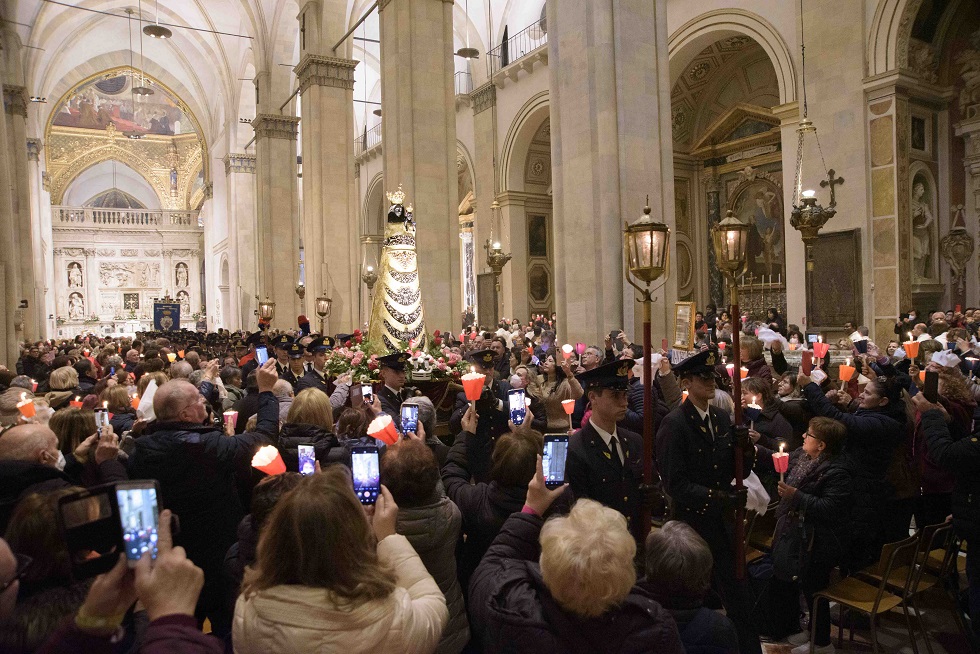
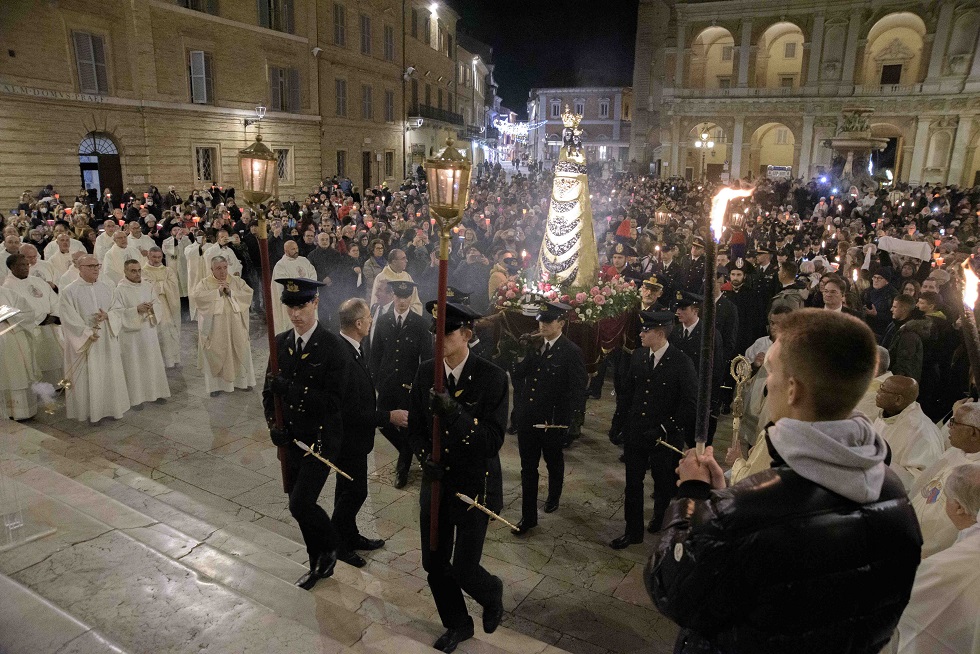
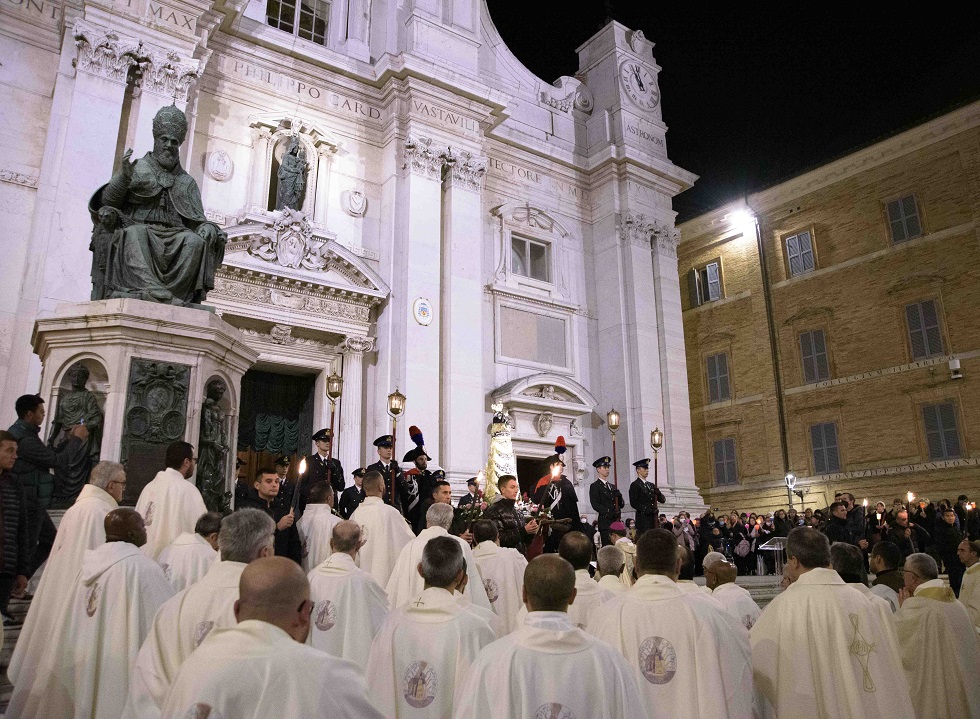
The celebrations for the Madonna di Loreto began on 9 and 10 December in the city of Loreto, where a delegation from the Armed Forces, led by Air Brigadier General Luigi Casali, Commander of the Air Force Academy in Pozzuoli (NA), together with Colonel Giancarlo Filippo, Commander of the Aviation English Training Centre in Loreto (AN), participated on the evening of 9 December in a prayer vigil celebrated by H.E. Archbishop Msgr. Fabio Dal Cin, Prelate of Loreto and Pontifical Delegate for the Holy House, followed by the traditional procession, which was also attended by cadets from the “Centauro VI” Course of the Air Force Academy, with the Sacred Effigy of the Blessed Virgin Mary of Loreto carried on the shoulders by personnel of the Blue Army amongst thousands of faithful and devotees to the SS. Patroness who crowded the Basilica and the parvis.
On the morning of 10th December, the celebrations continued at the Sanctuary of the Holy House of Loreto, where the solemn Eucharistic Celebration was held, presided over by H.E. Monsignor Rino Fisichella. At the end of the religious service, Air Force Corps General Silvano Frigerio, Commander of AM Schools / 3rd Air Region of Bari, representing the Chief of Staff of the Air Force, expressed the indelible emotion that, even after decades, the renewal of the tradition of the 10th December celebration has stirred in him. In his speech, he emphasised that for the Cadets of the Air Force Academy, this pilgrimage is proof of how the young students and attendees have already “[...] internalised the deep sense of affiliation that those who wear the Blue Uniform feel towards the Blessed Virgin of Loreto, whom they consider their Spiritual Mother and to whom they daily dedicate and entrust their work, from the simplest to the most complex activities”.
Historical notes
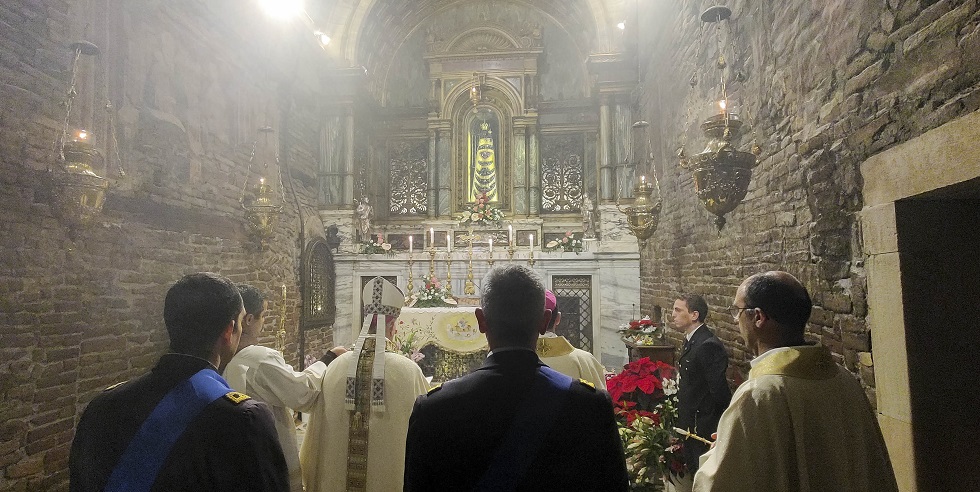
The Marian solemnity is linked to the tradition that the shrine, venerated at Loreto, is the room in which Mary was born in Nazareth, in Galilee, where she was educated and where she received the angelic Annunciation. The House of Nazareth had been transformed into a church from apostolic times. Composed of only three walls, it was placed at the opening of a cave dug into the rock, today preserved in the Basilica of the Annunciation in the Galilean city of the same name.
Legend has it that the “Holy House” in which Mary was born in Nazareth, preserved in the Basilica of the Madonna of Loreto, was transported by sea on Crusader ships by the “hands of angels”. This small biblical sanctuary, which fell into Muslim hands, was saved and first moved to Trsat, in present-day Croatia, in 1291, then to Ancona in 1293, where it remained for nine months, after which angels lifted it again to place it near Recanati and finally in Loreto on the night between 9 and 10 December 1294.
In 1920, the phenomenon of aviation, which had for a long time been limited and reserved for a relatively small number of enthusiasts captivated by the daring aspect of human flight, had seen significant growth, especially during the tragic period of the First World War. Concrete initiatives were set in motion to ensure that this new form of mobility would have its own celestial patron. The devout Loreto tradition seemed particularly suitable, and guided the choice towards the Madonna of Loreto.
The belief in this miraculous “flying” translation prompted Pope Benedict XV, welcoming the wishes of the pilots of the First World War, to name the Blessed Virgin of Loreto “Patroness of Aviators” with the Pontifical Brief of 24 March 1920. Mary's protection, therefore, is not limited to air transport operated by the Armed Forces, but extends to every person who travels and to all those, in the aircraft themselves or in ground services, who are responsible for the safety and peace of mind of those being transported.
City of Loreto
The consolidated existing relationships between the Air Force and ecclesiastical institutions, precisely at Loreto, have often transformed into concrete initiatives of solidarity. The Aviation English Training Centre itself is today located within the facilities that were originally the seat of the historic “Francesco Baracca” Institute. This Institute, named after the hero of the Air, was established as part of a series of humanitarian activities that, launched immediately after the proclamation of Our Lady of Loreto as the Patron Saint of Aviators, were intended for the families and orphans of airmen who were in poor financial condition. In 1925, these initiatives led to the establishment of the National Charitable Institution for the Widows and Children of Airmen, renamed in 1937 the National Institution for the Children of Aviators (ONFA), which was present in Loreto until 1983.