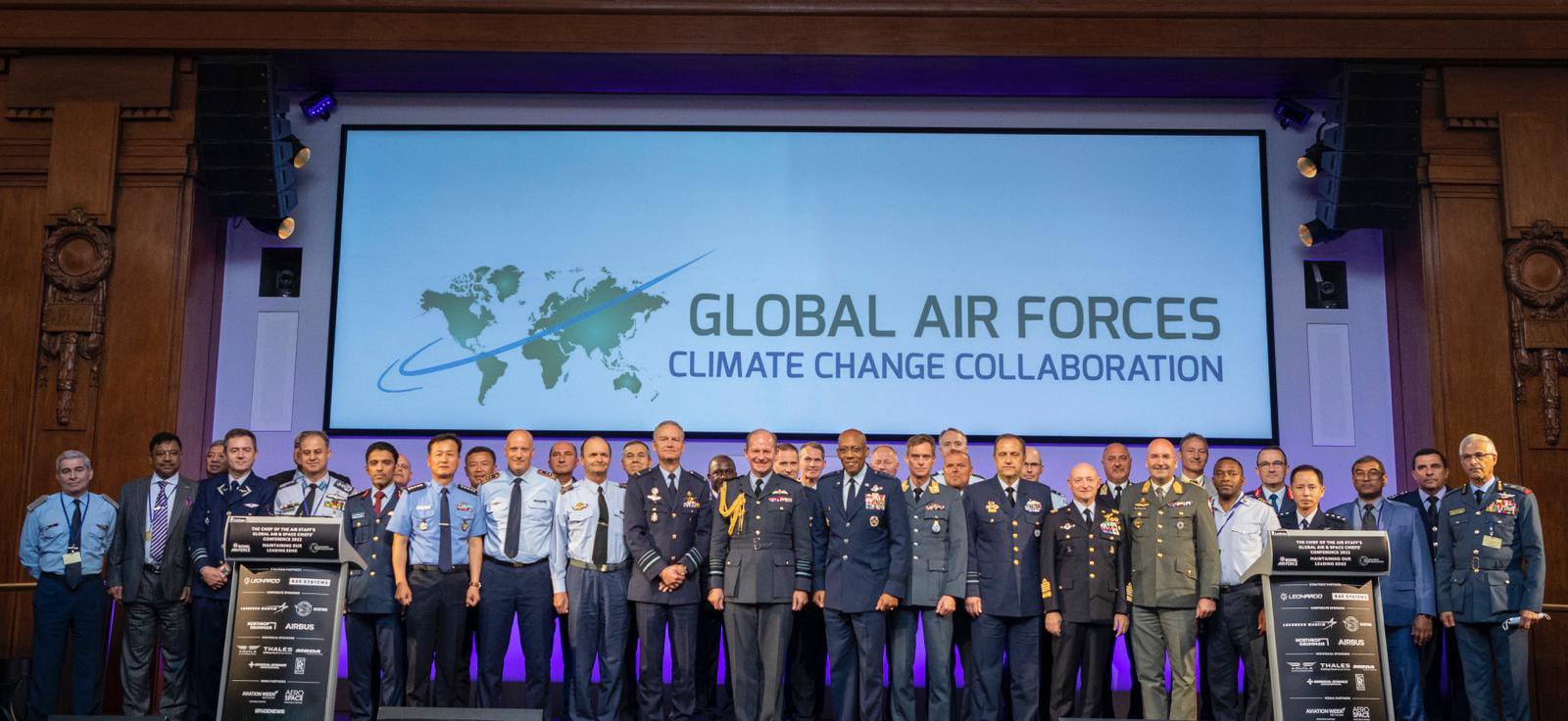
Representatives from the world's major air forces met at an international conference in London in order to improve energy efficiency and the “green” transition in aviation.
It Chief of the Air Staff, Air Squadriglia General Luca Goretti, jointly with the Chiefs of Staff and senior officers of air forces from around the world, participated, on 14 July in London, at the Global Air Forces Climate Change Collaboration (GAFCCC). During the event, the signing of: Declaration of Intent with which each Air Force commits to reducing its reliance on fossil fuels.
The’initiative originates from the new Energy Policy which the British government presented in December 2020 with the publication “Energy White Paper – Powering our Net Zero Future“, with which precise guiding lines are established with the aim of completing,", enter It 2040, the Transition Ecological. Tale ambitious goal requires a profound transformation of the production system and industrial processes, including the broader concept of a functional supply chain for the delivery of goods and services.
The Italian Air Force is at the forefront of the fight for environmental sustainability and against climate change and, as part of the initiative Global Air Forces Climate Change Collaboration (divided into macro functional areas) will have the delicate role of leading the function Infrastructure & Estate, for which, in addition to the GAFCC Deputy Chief meeting held in March 2022 in Rome with the participation of 25 air forces, will host next October a working group at the 3rd Wing of Verona-Villafranca.
The technical table “InfrastructureEstate“ è One fundamental pillar of the’initiative for adapt e improve the infrastructure Con Low environmental impact technology. It provides for A.M. leadership in the area of “projection”, centred on’Independence Energy Unit Concept of mobile structures, attested to the capabilities of 3rd Wing at Verona Villafranca; which in the context of “resident”, with the Blue Airports initiative, one of the pillars of Major Infrastructure Projects of the Defence, an initiative aiming to achieve – in the coming years – a vast plan of modernisation ed efficiency of the strategic infrastructure of the FFAA.
The lines of action The main ones are two: the first is to adopt the technological and infrastructural standards that new/future weapon systems require, the second is to simultaneously adapt to all those environmental standards that derive both from a renewed regulatory framework and from a new concept of energy resilience/independence from external sources.
The’Italian Air Force it is at the forefront of the fight for the Environmental sustainability and against climate change. To this end, pilots and technicians from the Flight Experimental Department and the Aeronautical and Space Materials Technologies Department of the Air Experimentation Department of Aeronautics and Space (DASAS) of Pratica di Mare, together with researchers from Enea and CNR, they have been busy recently in a series of flight tests with an AMX jet powered by a fuel mixture containing up to 25% biofuel. This constitutes a promising alternative to conventional fuel as obtained, precisely, from renewable sources.
It 3rd Wing It depends on the Head of the Support Service of the Air Force Logistics Command (Rome), it is based at Villafranca di Verona airport and acts as an “initial strategic facilitator” for the Italian Air Force's projection logistics capabilities. It is capable of projecting Operational Support and Logistic Support both in Italy and abroad.
The’RSV It is the Department responsible for the preparation and execution of all ground and flight tests for aircraft and prototypes of equipment used in flight operations. The Flight Experimental Department is organised into the 311th Flight Squadron, the Technical Squadron, the Software Management Squadron, and the Aerospace Engineering Squadron. It employs experimental test pilots and navigators, experimental engineers, technicians, and mechanics.