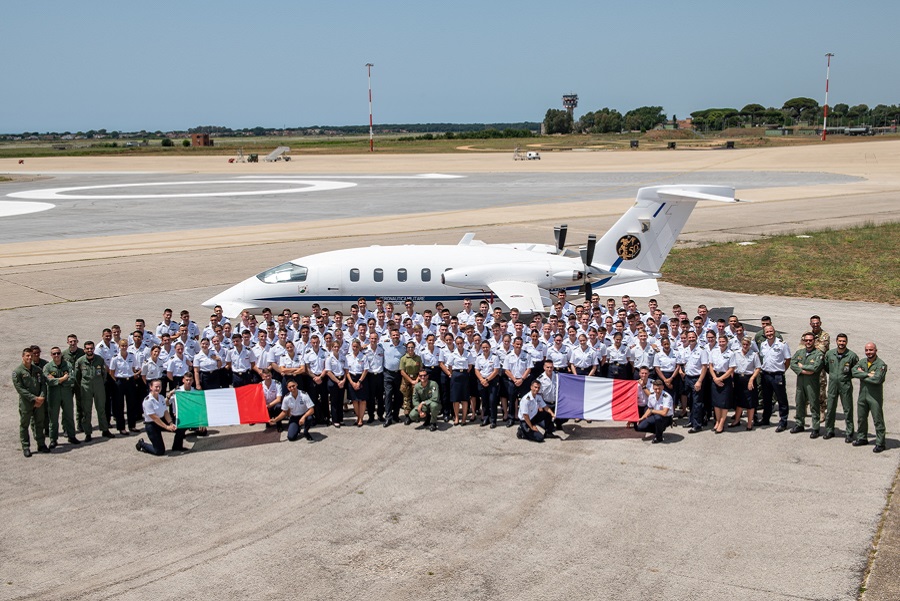
A day dedicated to the Italian Air Force's aerospace capabilities
On Monday 17 July, Pratica di Mare Airport hosted a delegation of approximately one hundred and fifty cadets and instructors from the’French Air and Space Academy in Salon-de-Provence for a tour that will take them to other European aeronautical sites.
The delegation, led by the Lieutenant Colonel Vincent Gauthier, Coordinator of the French Air and Space Academy Courses and from the Major Stephen Price, Tutor for the Cadets of the 2nd Course, was welcomed by Air Division General Alessandro De Lorenzo, Commander of the Air Division for Aeronautical and Space Experimentation (DASAS) who first thanked the guests for choosing Pratica di Mare Airport and DASAS as their destination for their visit to Italy, and then described the unique capabilities that the Division expresses on a daily basis.
Subsequently, Colonel Giuseppe Gentile, of the’General Office of Space and Defence Staff, Head of S.M.D., presented the Italian Defence's perspective on the doctrinal and capability development of the space domain, with a particular focus on current and future collaborations with the French partner, and those of the Deputy Commanders of the 14th Wing and Multi Crew Training Centre (MCTC) which have described the activities of their respective Departments.
There were many questions from the cadets, demonstrating the interest aroused by the topics discussed, particularly regarding the technological development achieved by the Air Force in the aerospace field.
The visit continued to Department of Aerospace Technologies and Materials (RTMAS) of the DASAS, the first stage of the learning process, where the Department Head, Colonel Fabrizio De Paolis, illustrated the Department's specific activities. The guests were then taken to the physico-chemical laboratories where they were able to observe the analyses and tests carried out by technicians and specialists on fuels and aeronautical components.
Particular interest was shown by the cadets in the Biofuel, and Aerospace propellant contain between 20% and 25% per cent of biofuel from certified sources, and the process of Non-Destructive Testing (NDT), which means a set of analytical techniques based on physical principles that can provide information on the structural integrity and condition of aerospace components of interest, without altering their physical state and thus capable of increasing the Flight Safety. In general, the level of expertise and instrumentation of the Department was appreciated, capable of providing data and evaluations on performance, effectiveness and material safety and weapon system structures.
The second stage of the visit took place at the hangars of the 14th Wing, where pilots and cabin crew described the technical and operational capabilities of the aircraft present, while specialists from the Aircraft Efficiency Group (G.E.A.) illustrated the maintenance activities carried out on the aircraft assigned to the Department. The delegation then had the opportunity to observe the Gulfstream G-550 aircraft in its version up close Conformal Airborne Early Warning (CAEW), weapon system equipped with multi-sensor for air surveillance, command, control and communications functions. The aircraft is regularly deployed both nationally and in support of NATO, contributing to effectively ensuring the security of the skies.
The cadets also boarded a Boeing KC-767A configured in a COMBI version, where the pilots and Air-to-Air Refueling System Operators (OSRV) explained the technical peculiarities of the aircraft, particularly its capabilities Air to Air Refuelling (AAR) and the multi-role one. The KC-767A, in fact, thanks to the flexibility of varying its configuration (COMBI, CARGO, and FULL PAX), allows for the carrying out of Passenger and material transport missions, as well as those of Strategic medical evacuation, as well as, missions of Bio-containment healthcare transport of highly infectious patients. The Italian Air Force's KC-767A aircraft constitute a valid NATO asset and are fundamental to the European Defence security framework. They are, in fact, embedded in the European system European Air Transport Command, along with other assets belonging to the Air Forces of France, Germany, Spain, and the Netherlands.
It was then the task of a team of Flight Instructors, Flight Attendants and Pilot Attendees of the CAE Multi Crew, one of the Air Force's International Flight Schools, welcomed the delegation and showcased the systems with which the Department trains military pilots, Italian and foreign, destined for transport aircraft. In particular, the ALSIM ALX FNTP II static flight simulator, with which they are instructed on the basics of working in an environment Multi crew, in all forms of flight; the PIAGGIO P180 AVANTI I aircraft, with which personnel train in Italy and abroad on missions of combat – service – support. The cadets and accompanying Officers from the French Air and Space Academy showed particular interest in the type of flight training delivered by the School with the Italian aircraft, in accordance with high European training standards sanctioned by the programme. European Undergraduate Military Transport Pilot Training (EUMTPT) recently concluded and with which the Centre assumed the title of European Defence Airlift School (EDAS Italy).
Overall, the visit of the French Air and Space Academy to Pratica di Mare Airport represented a moment of effective and synergistic encounter from an experiential and multidisciplinary point of view, both for the French cadets and for the flight and specialist personnel of the involved Departments. More generally, this event contributed to strengthening the partnership between the Italian and French Air Forces.
The Air Experimentation Department of Aeronautics and Space It represents the first and only example in Italy of the rationalisation and centralisation within a single structure of individual study and experimentation centres dependent on an Armed Force. An Entity that, in synergy with national and international aeronautical excellences, carries out study, experimentation, testing, technical-operational evaluation, and research support for new aeronautical weapon systems, also for the benefit of other Armed Forces and/or Armed Corps of the State, when required.
The DASAS also ensures technical-logistical, administrative and operational support to Air Force Bodies/Departments located on the airport site, as well as to Bodies of other Armed Forces and State Armed Corps present. Finally, it ensures the services necessary for the safe and effective carrying out of flight activities and the management of activities connected to the reception, embarkation and disembarkation of men, materials and vehicles arriving at and departing from Pratica di Mare airport.
In particular, the activities carried out by the Aeronautical and Space Materials Technologies Department cover all materials used in aeronautics and space, including those for armaments, falling within the scope of Materials science, analytical chemistry, applied chemistry and commodities science. In these fields, the Department demonstrates capabilities in analysis, control, investigation and experimentation. Furthermore, it is tasked with performing technical-operational assessments, trials, and efficacy investigations of weapon systems and armament materials of aeronautical interest, carrying out training and qualification activities for personnel in all these spheres.